

The basic principle
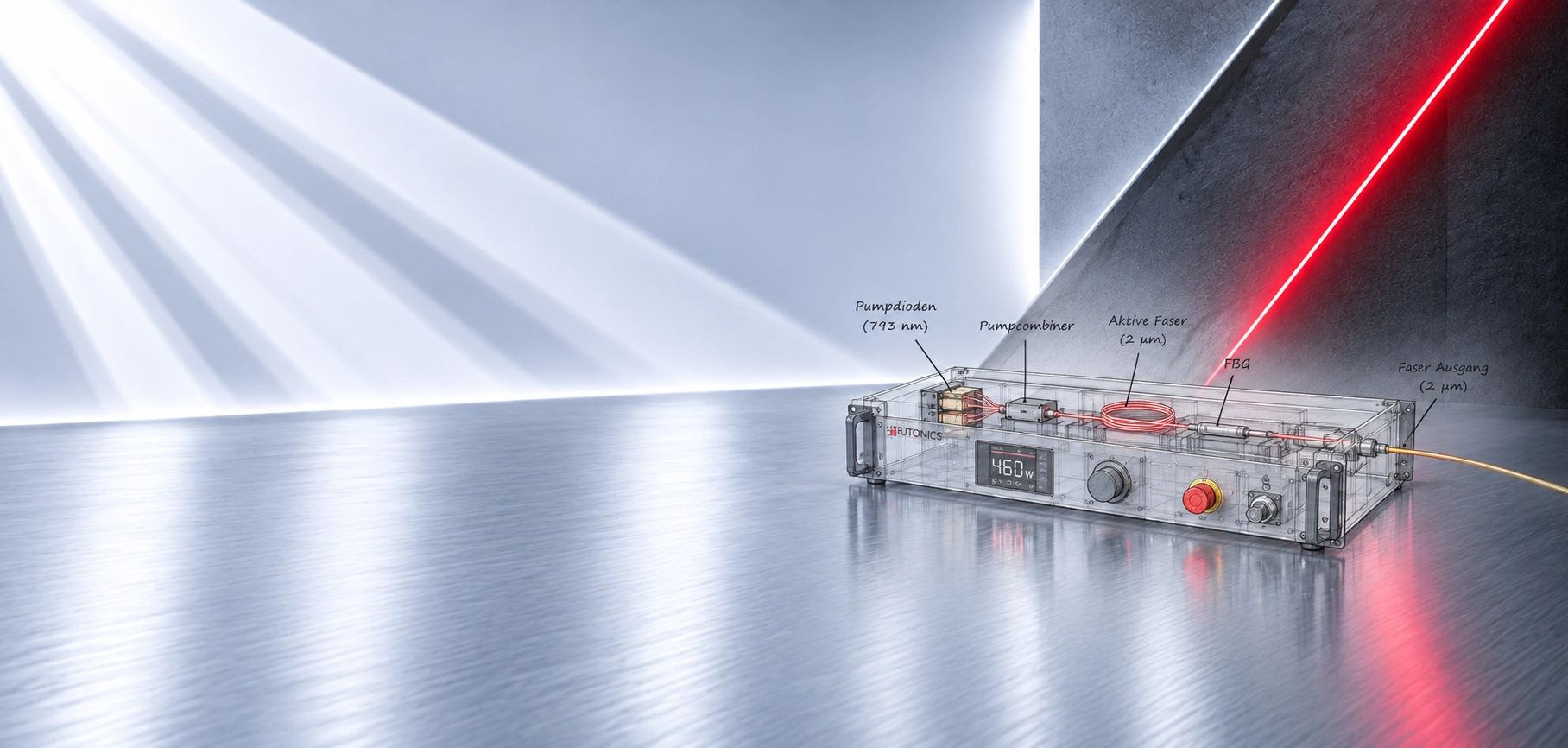
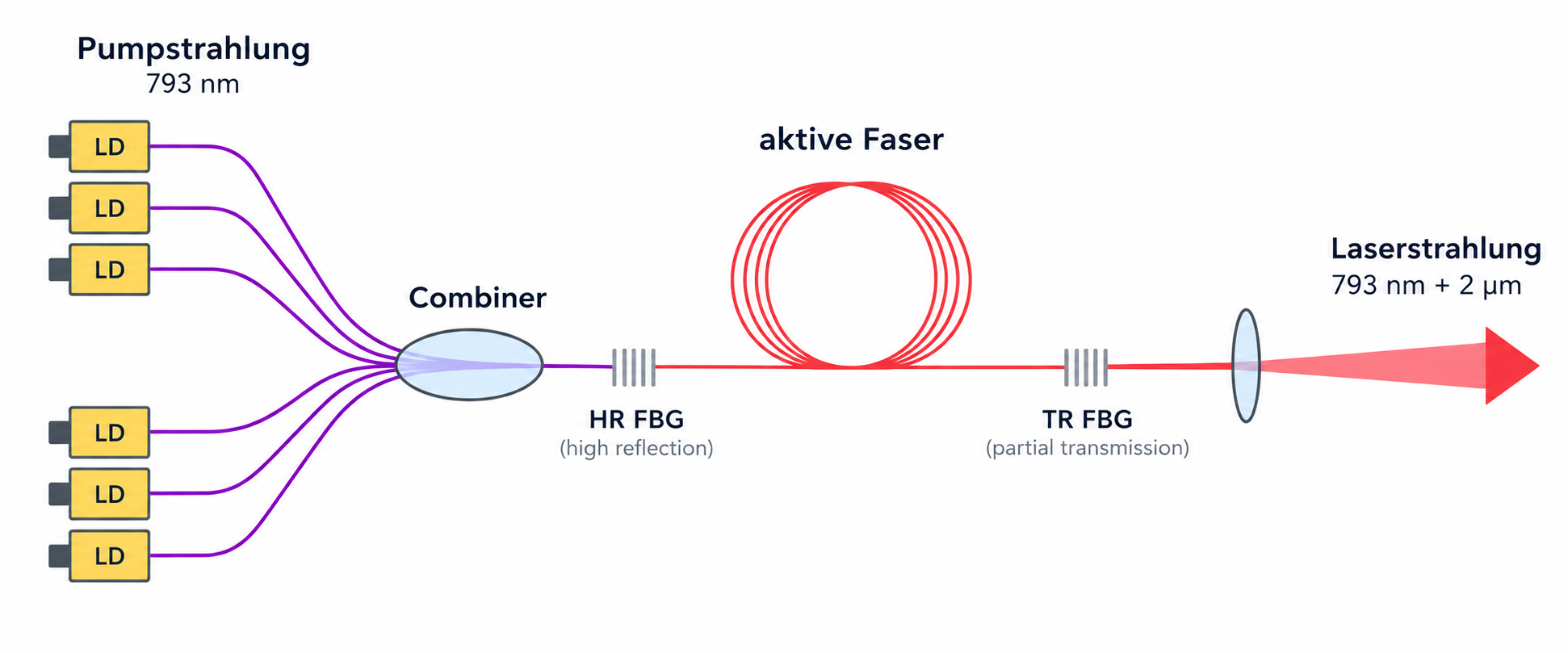
A thulium fiber laser is a solid-state laser whose gain medium is a glass fiber doped with thulium ions. Pump diodes supply optical energy, exciting these ions. As they return to a lower energy state, they can generate laser light around 2 µm.
The active fiber, pump combiner, fiber Bragg gratings and output form the optical system. The gratings act as resonator mirrors, providing feedback and helping define the wavelength. Directly connecting the optical components in a monolithic fiber architecture reduces free-space beam paths and alignment requirements.
Why wavelengths around 2 µm matter
Plastics, organic materials and water-containing media absorb light differently around 2 µm than at the widely used 1 µm wavelength. Depending on the material, this can improve energy coupling and process control in industrial, medical and scientific applications.
High-power systems in this spectral region also place demanding requirements on optical components and thermal management. The laser architecture is therefore an important part of achieving stable operation.
High-power oscillator or MOPA?
MOPA stands for Master Oscillator Power Amplifier. A seed laser generates a low-power signal that is amplified in one or more subsequent stages. This architecture can be useful for applications requiring particular pulse shapes, ultrashort pulses or specialized modulation.
Futonics instead generates high output power directly inside the resonator. The high-power oscillator requires no separate seed stage or downstream power amplifier. This simplifies the optical system and supports robust operation in the 2 µm range.
Advantages of the oscillator approach
Removing separate amplification stages reduces the number of optical components and potential sources of loss or failure. It also avoids sensitive seed and amplifier stages that can be affected by back reflections, amplified spontaneous emission and parasitic oscillations.
Fewer stages mean fewer thermally critical areas and less gain drift. Together with an appropriate resonator design, this supports efficiency, thermal stability and reliable continuous operation.
- Simpler, monolithic optical architecture
- Fewer internal loss sources
- Robustness against back reflections
- Stable operating conditions at high power
Futonics fiber Bragg grating technology
Fiber Bragg gratings (FBGs) are precise mirrors inside the fiber. Their stability is essential for the resonator: local heating can shift the Bragg wavelength and affect long-term reliability.
Futonics has developed its own FBG process for high-power oscillators. According to Futonics, gratings produced with this process show no measurable heating even at very high laser powers. This supports stable resonator conditions during continuous operation.
Control over this process allows Futonics to adapt critical resonator components specifically to high-power operation around 2 µm.
Controlling nonlinear effects
At high optical powers, stimulated Brillouin scattering (SBS), stimulated Raman scattering (SRS) and self-phase modulation can limit power scaling and spectral stability.
The fiber and resonator design must account for these effects, especially in single-mode systems, narrow-linewidth lasers and long active fibers. The goal is reproducible output with controlled spectral properties and high beam quality.
High power and high beam quality
A well-designed single-mode thulium oscillator can combine high output power with excellent beam quality. Beam propagation, polarization and spectral behavior all matter for precision applications.
Generating power directly in the resonator avoids additional amplifier stages. Achieving this at high power requires a coordinated design of the complete fiber resonator and its thermal behavior.
Typical applications
The wavelength range around 2 µm opens up opportunities wherever material absorption and beam quality are important. The suitability of a laser depends on the specific material and process.
- Materials processing, including reflective targets
- Transparent and specialized plastics
- Medical and biophotonic applications
- Research, development and spectroscopy
Why Futonics uses high-power oscillators
Futonics combines a monolithic fiber architecture with its own thermally stable FBG technology. High power is generated directly in the oscillator, with fewer optical stages and internal loss sources.
This approach provides a platform for demanding industrial, medical and scientific applications around 2 µm where reliability, efficiency and beam quality are key priorities.
From technology to your application
Explore our continuous-wave and quasi-continuous-wave thulium fiber lasers in the 2 µm wavelength range.
Explore thulium fiber lasers